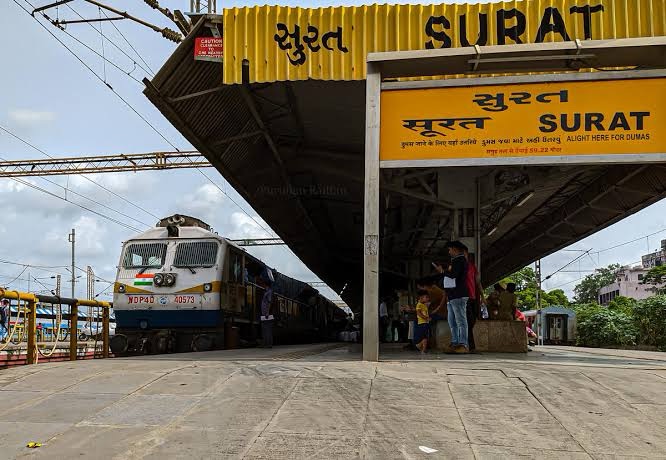

Bringing a Vande Bharat Express to the Surat ↔ Bhavnagar Corridor
Introduction
The western region of Gujarat is rapidly evolving in terms of rail connectivity and infrastructure. The approximately 520–550 km rail corridor between Bhavnagar Terminus (BVC) and Surat Railway Station (ST) remains an important link between Saurashtra and South Gujarat. Given the broader push by the Indian Railways for higher-speed, premium services, the route emerges as a strong candidate for a premium train service such as the Vande Bharat Express.
Recent announcements by the ministry highlight that a Vande Bharat train between Bhavnagar and Surat is under consideration.
Why This Route Makes Strategic Sense
Distance and Profile
The corridor length of around ~500–550 km fits well with the operational profile of Vande Bharat trains sufficiently long to deliver meaningful journey-time reductions, but not so long as to make multiple intermediate stops or extensive maintenance complexities prohibitive.
Official Announcements & Demand
During a visit to Bhavnagar, Union Railway Minister Ashwini Vaishnaw announced that a Vande Bharat service between Bhavnagar and Surat is planned in the near future. State-level media report that the service “soon” will be operational between Bhavnagar and Surat, though station works at Surat could delay immediate launch. Local representation from Bhavnagar MP Nimuben Bambhaniya has affirmed the community demand for Vande Bharat connectivity to Surat.
Connectivity & Regional Growth
Linking Bhavnagar more directly to Surat an industrial, commercial hub boosts the logistics and passenger network. This route also strengthens Saurashtra’s link to South Gujarat, supporting economic growth, rail-infrastructure development and passenger convenience.
Benefits
For Passengers: Faster, more comfortable travel between Bhavnagar and Surat; day-return feasible; modern amenities. For Railways / Government: Advances the modernisation agenda of Indian Railways; shows investment outside major metro-corridors; better asset utilisation. For the Region: Stronger link between industrial centres; improved mobility; potential uplift in business/trade/commuting. For Infrastructure: Motivates upgrades to track-work, signalling, station facilities along the corridor.
Key Challenges & Considerations
Infrastructure Readiness: Track speed, signalling, station works especially at Surat must support higher average speeds. ABP news flagged that due to works at Surat station, the service cannot be launched immediately. Scheduling & Pathing: The corridor is already used by freight and other passenger services ensuring a clear path for a high-speed service is essential. Demand Forecasting: Premium services attract higher fares modelling demand on this corridor is essential. Operational Costs/Maintenance: Rolling stock allocation, maintenance facility support, crew training all factor into feasibility. Stop Pattern Trade-off: More halts = greater accessibility; fewer halts = faster journey need the right balance. Launch Timing: Given current station infrastructure works (e.g., at Surat), the “soon” timeframe requires realistic planning.
Outlook & Next Steps
According to official sources:
A survey and preparatory work for the Bhavnagar–Dholera new railway line has been approved, showing broader railway investment in this region. The announcement by the Minister at Bhavnagar (August 2025) flagged that the Vande Bharat option for Bhavnagar–Surat is being pursued.
Next steps might include:
Finalising the stop pattern and timetable. Confirming rolling stock allocation (Vande Bharat rake). Ensuring Surat station (and any stops) are fully ready for the service. Publicising the service and integrating ticketing/marketing. Setting a target launch window (e.g., after station-works completion).
Conclusion
The Bhavnagar ↔ Surat corridor is emerging as a strong candidate for a premium high-speed service like Vande Bharat. With official nods, demand signals and regional connectivity imperatives all aligning, the railways have a real opportunity to deliver substantial travel-time savings and service uplift. For stakeholders from passengers to businesses to regional planners, this is a promising development to watch.

