Nearly 80% of Indian Railways tracks are now capable of supporting speeds over 110 kmph.
Nearly 80 per cent of India’s railway track network is now capable of supporting train speeds exceeding 110 kmph, reflecting a significant transformation in rail infrastructure over the past decade, the Ministry of Railways informed the Lok Sabha on Wednesday (10 December).
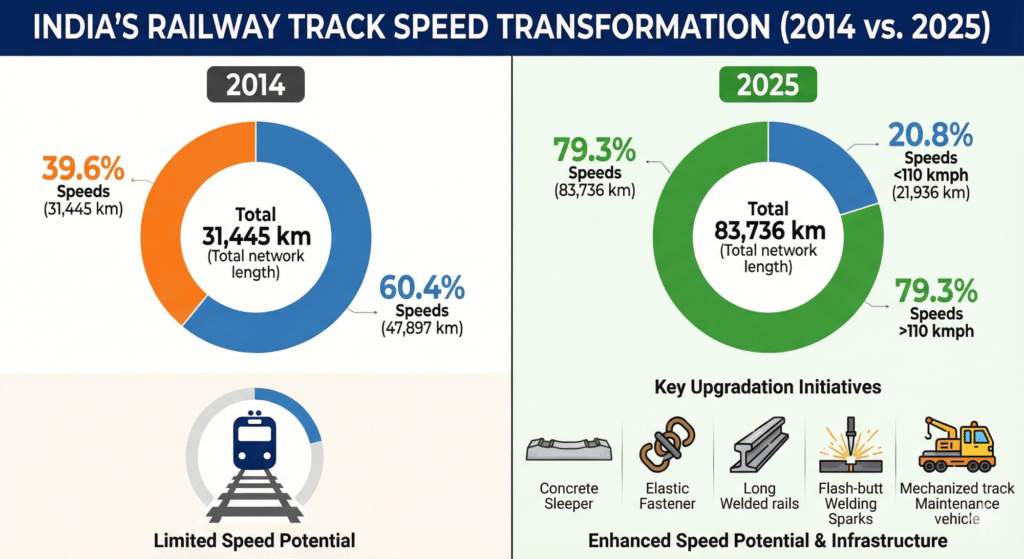
In a written reply, Railway Minister Ashwini Vaishnaw stated that track sections designed for speeds of 110–130 kmph and 130 kmph and above together span 83,736 km, accounting for 79.3 per cent of the total railway network as of November 2025. This marks a sharp rise from 2014, when only 31,445 km about 39.6 per cent of the network was rated for speeds above 110 kmph.
The highest speed bracket of 130 kmph and above has seen the most notable growth, expanding more than fourfold from 5,036 km (6.3 per cent) in 2014 to 23,010 km (21.8 per cent) in 2025. Similarly, tracks supporting speeds between 110–130 kmph have increased from 26,409 km to 60,726 km, now forming the largest segment of the network.
At the same time, the length of tracks limited to speeds below 110 kmph has reduced substantially from 47,897 km in 2014 to 21,936 km by November 2025 bringing their share down to 20.8 per cent of the total network.
Vaishnaw attributed this progress to extensive track upgradation initiatives undertaken over the past 11 years to enhance speed potential across Indian Railways. These measures include:
Installation of wider pre-stressed concrete sleepers to improve track stability Adoption of elastic rail fastenings for enhanced vibration control Deployment of long welded rails to minimise joints and speed restrictions Use of advanced flash-butt welding technology for stronger rail joints Mechanised track maintenance with high-output machines to ensure precision and efficiency